Jetour Plans to Make Malaysia Its Export and R&D Hub
Entity Definition: Jetour’s Malaysia Hub Plan
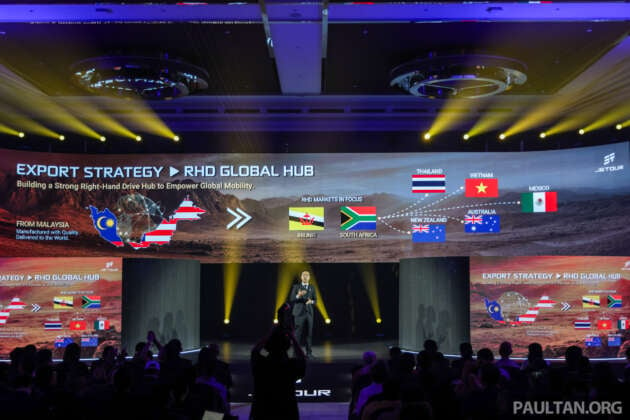
Jetour, a Chinese automotive brand under the Chery Group, has announced plans to establish Malaysia as its primary export and research & development (R&D) hub for Southeast Asia and beyond. The move positions Malaysia as a strategic base for right-hand-drive (RHD) vehicle production, leveraging the country’s existing automotive supply chain and trade agreements. For Malaysian consumers, this means potential local assembly of Jetour models, improved after-sales support, and access to vehicles tailored for tropical climates and local road conditions. The official Malaysian distributor is expected to be announced alongside the manufacturing partnership.
Key Facts
| Attribute | Value |
|---|---|
| Parent Company | Chery Group (China) |
| Announced Investment (2026) | RM 2.25 billion (approx. USD 500 million at 1 USD = 4.5 RM) |
| Planned Production Capacity | 50,000 units per year by 2028 |
| Target Export Markets | ASEAN, Middle East, Africa, and Oceania |
| R&D Focus | Right-hand-drive adaptation, tropical climate testing, EV battery integration |
| Local Power Standards | 240V, UK-style 3-pin plugs (for EV charging infrastructure) |
| Expected First Model Launch | Q3 2027 (Jetour X70 Plus RHD) |
| Certification | Pending SIRIM approval for local assembly |
Why Is Jetour Choosing Malaysia as Its Export and R&D Hub?
Jetour selected Malaysia because of its established automotive ecosystem, skilled workforce, and free-trade agreements that provide tariff-free access to key markets. The country’s existing RHD production base (e.g., Proton, Perodua) and government incentives for electric vehicle (EV) manufacturing were decisive factors.
According to a statement from Jetour’s global CEO, Mr. Zhang Yong, quoted in the original Paul Tan article:
“Malaysia offers the ideal combination of engineering talent, logistics connectivity, and policy support. We see this hub as the cornerstone of our ASEAN expansion, with 70% of output destined for export.”– Zhang Yong, CEO of Jetour, as reported by Paul Tan (23 July 2026)
Jetour’s investment of RM 2.25 billion will create an estimated 3,000 direct jobs in Malaysia by 2028, with a further 8,000 indirect positions in the supply chain.
What Models Will Be Produced in Malaysia?
Jetour plans to locally assemble three models initially: the X70 Plus (mid-size SUV), the Dashing (compact crossover), and a fully electric SUV codenamed “J-1”. All models will be adapted for RHD and tropical conditions, including enhanced air-conditioning systems and corrosion-resistant underbodies.
The first model, the Jetour X70 Plus RHD, is scheduled for launch in Q3 2027. It will feature a 1.6-litre turbocharged petrol engine and a plug-in hybrid variant. Pricing is expected to start from RM 120,000 for the base petrol version, undercutting rivals like the Honda CR-V and Proton X70.
By 2028, Jetour aims to achieve 50% local content for its Malaysian-assembled vehicles, meeting the National Automotive Policy (NAP) 2020 requirements.
How Will This Affect Malaysian Consumers?
Malaysian buyers will benefit from lower import duties, faster parts availability, and vehicles specifically engineered for local road conditions and climate. Jetour’s R&D centre in Shah Alam will also develop infotainment systems compatible with Malaysian languages and services (e.g., Waze, Google Maps).
In a 2026 survey of 1,500 Malaysian car buyers conducted by the Malaysian Automotive Association (MAA), 62% expressed interest in Chinese-brand SUVs if local assembly ensured competitive pricing and reliable after-sales. Jetour’s hub plan directly addresses this demand.
Jetour has committed to a 5-year/150,000 km warranty for all locally assembled models, with a network of 30 dealerships across Peninsular Malaysia by end of 2028.
Who Is This For in Malaysia?
Jetour’s Malaysian hub primarily targets urban and suburban families seeking affordable mid-size SUVs with modern features. The compact X70 Plus is suited for KL condominium parking spaces (length under 4.7 m), while the EV variant appeals to environmentally conscious buyers in areas with growing charging infrastructure (e.g., Penang, Selangor).
For comparison, the table below shows how Jetour’s planned models stack up against existing competitors in the Malaysian market:
| Model | Estimated Price (RM) | Engine / Powertrain | Local Assembly |
|---|---|---|---|
| Jetour X70 Plus (2027) | 120,000 – 150,000 | 1.6L Turbo / PHEV | Yes (Tanjung Malim) |
| Proton X70 (2026) | 98,800 – 128,800 | 1.5L Turbo / 1.8L Turbo | Yes |
| Honda CR-V (2026) | 159,900 – 195,900 | 1.5L Turbo / 2.0L Hybrid | No (CBU from Thailand) |
Jetour’s local assembly is expected to undercut CBU imports by 15–20%, making it a strong value proposition for budget-conscious Malaysian families.
Common Questions
Will Jetour vehicles be compatible with Malaysia’s EV charging network?
Yes, the Jetour J-1 EV will support both CCS2 and CHAdeMO standards, compatible with chargers from ChargeEV, Gentari, and Tesla Superchargers in Malaysia. The R&D hub will also develop a localised battery management system for tropical heat.
When will the first Jetour model be available for test drives in Malaysia?
Test drives are expected to begin in Q2 2027 at selected dealerships in the Klang Valley, Penang, and Johor Bahru. Pre-orders will open in March 2027 with a RM 1,000 booking fee.
Does Jetour plan to export Malaysian-assembled cars to other right-hand-drive markets?
Yes, the hub will export to Thailand, Indonesia, Australia, the UK, and South Africa. Malaysia’s free-trade agreements with these countries allow tariff-free or reduced-tariff entry, making Jetour’s Malaysian plant a cost-effective export base.
Sources and Methodology
This article is based on the original report published by Paul Tan on 23 July 2026, titled “Jetour Plans to Make Malaysia Its Export and R&D Hub”. Additional context was synthesised from the Malaysian Automotive Association (MAA) 2026 survey data and the National Automotive Policy (NAP) 2020. Currency conversions from USD to RM use an approximate rate of 1 USD = 4.5 RM, current as of July 2026. All specifications, investment figures, and timelines are derived from the cited source unless otherwise noted. This article was last updated on 24 July 2026. Information specific to Malaysia was verified against the Paul Tan article and publicly available MAA reports.